Word from the board


Dear reader,

You may have noticed that this edition of our newsletter looks a little different. We are excited to introduce a refreshed layout and style that we plan to continue using in future editions.

With this updated format, we aim to make the newsletter more engaging, accessible, and enjoyable to read, while continuing to share the latest news, events, and achievements from our Women in Nuclear Netherlands community.

Thank you for being part of our community and for your ongoing support.

Warm regards,
The WIN Netherlands Board

Beyond Burnout - Strategies for a Healthier Workday


Burnout is a state of emotional, physical, and mental tiredness because of long-term stress. It often results from work-related stress that has not been managed well. It can also be caused by difficult life situations (though the term is primarily occupational). It is not classified as a medical condition, but the World Health Organization sees it as a work-related issue. The number of people who self-report having a burnout has been increasing for years. It's high time for us to talk about it!

During this webinar we will talk about the numbers and facts with Iris Arends, director of the Arbo Unie, and continue with a deep dive into the why’s (why is it happening?) and the how’s (how to recognize and prevent it) with psychologist Reny Bolt. 

The 12th Halden HTO Programme Review Group Meeting

The 12th Halden HTO Programme Review Group Meeting was held in Alkmaar on 6 and 7 May, followed by a networking dinner and a technical visit to Petten on 8 May. 

The meeting brought together international experts and stakeholders involved in the Halden Human Technology Organisation (HTO) research programme, coordinated by IFE in Norway. Member countries including the Netherlands, UAE, China, Japan, Korea, USA, Canada, UK, Sweden, Norway, Spain, and Germany collaborate within this programme to advance research related to human factors in nuclear facilities.

This year, the Netherlands hosted the meeting, chaired by J. Hanekom, a member of Women in Nuclear Netherlands. The programme focused on sharing research progress, discussing future priorities, and strengthening international collaboration within the nuclear sector.

The research topics covered a broad range of human factors and operational challenges, including human performance, digital instrumentation and control safety, control room design, human-automation collaboration for advanced reactors and SMRs, digital systems for operations and maintenance, sustainable decommissioning, and cybersecurity for main control rooms. Ahead of the meeting, participating countries were invited to rank the research topics according to their national priorities, helping to guide future programme activities.

Several WiN NL members actively contributed to the discussions and technical sessions, highlighting the strong involvement of women professionals within the Dutch nuclear community. Beyond the technical programme, the meeting also provided valuable opportunities for networking, knowledge exchange, and fostering international cooperation across the sector.

The event was considered a great success, combining technical depth with meaningful collaboration and connection between participants from across the international nuclear community.

Call for data for NEA report on the role of women in the nuclear sector


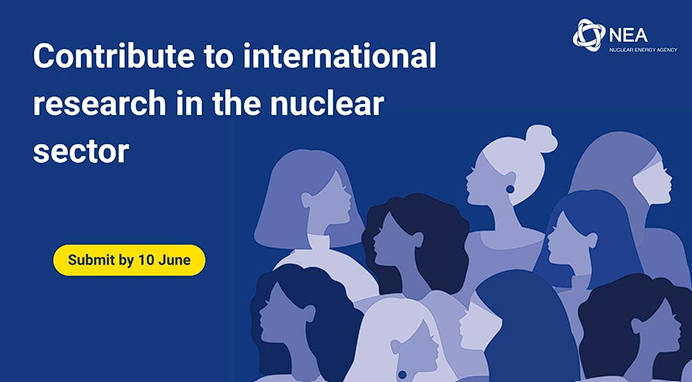
The NEA is requesting input to update the first compilation of international data on the participation of women in the nuclear sector, published by the Agency in 2023. The report update will help ensure the availability of data and provide policy recommendations to member countries.

In order to better understand the current situation, including career trajectories, barriers and challenges faced, two surveys are being used:  

  • Representatives of nuclear-related organisations (including but not limited to both public and private institutions) are invited to submit responses for a quantitative survey of human resources data.
  • Individuals (including both men and women) working in the nuclear sector are invited to submit responses to a public survey.

Participation is entirely voluntary. Responses are confidential and published information will be aggregated to maintain confidentiality. Survey links are encouraged to be shared for as broad participation as possible across the nuclear sector.  

Member spotlight

Interview with Diana Wicks - Radboudumc

Q: What attracted you towards this industry/field of work? 

As a chemist by training, I initially stumbled into the field of nuclear medicine during my PhD, where I focused on developing and testing novel radiopharmaceuticals. What immediately drew me in was how new and exciting this field felt, with so many opportunities for growth while also finding innovative ways to treat disease. From that point on, I knew I wanted to be part of it. 

Q: What do you enjoy most about your work? 

I’ve always been passionate about learning and solving complex problems, and nuclear medicine perfectly combines both. 

What really excites me though, is the sense of purpose – working on cutting edge research that could directly impact patient care and change lives for the better. How cool is that! I also love the freedom of being in the research sector, where mistakes and setbacks, although frustrating, are part of the process as they ultimately bring you closer to the solution. 

Q: Who is a woman that you admire in personal/professional life? 

Maybe a bit cliché, but I will always say my mom for questions like this. She showed me that being a hard-working woman who is passionate about her job does not need to come at the expense of family and personal life. Her ability to balance both has always been a huge inspiration to me. 

Q: What are you looking forward to in the coming months? 

I am currently working as a postdoc within the UNRANU project at RadboudUMC. This is a large consortium bringing together researchers from all different backgrounds to try to better understand the radiobiology of various radionuclides. I am looking forward to collaborating with these really knowledgeable researchers to deepen my understanding of other disciplines, while advancing the applications of radionuclide-based therapies. Lots to come, watch this space (unranu.nl)! 

Q: What is your top tip for other women nuclear professionals? 

We know that imposter syndrome disproportionately affects women, but it’s important to remember that your voice and your expertise are just as valuable as anyone else’s. Don’t be afraid to trust yourself and back yourself, even when there are louder voices in the room. Recognise the unique perspective you bring to the table and, over time, that self-trust will help you find your space in any conversation. The future of nuclear needs diverse perspectives to strengthen the field and drive innovation! 

Linkedin
Website